

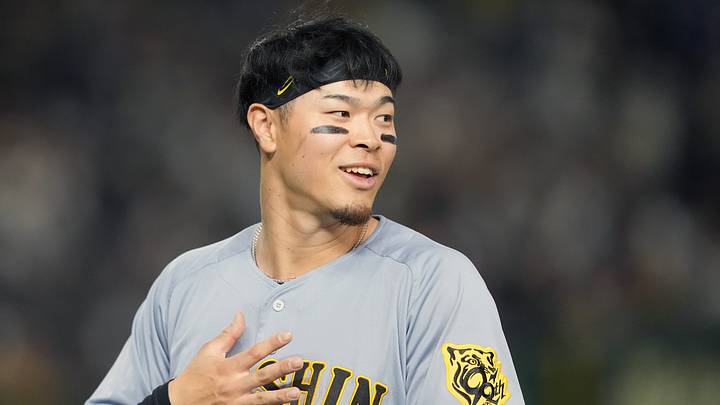
For the second straight offseason, a slugger from Japan was posted by his NPB club and will make the move to the big leagues next season. Last offseason, Kazuma Okamoto and Munetaka Murakami joined the ranks of big league players, with Okamoto landing in Toronto and the White Sox shocking the world to land Murakami. 3B/OF Teruaki Sato is the big-name position player making the transition to the states this offseason, and he cashed in with a large free-agent contract to join the Chicago Cubs. Without Munetaka Murakami’s success in 2026, things may have gone quite a bit different for Sato.
When it comes to power, Munetaka Murakami and Teruaki Sato are two of the most prodigious power hitters in the recent history of the NPB. Over 803 NPB games, Sato slugged 163 home runs, while Murakami hit 246 in 892 games. Both players posted career slugging percentages over .500 and won a triple crown, Murakami in 2022 and Sato in 2026. Both players posted career batting averages in the .270 range in Japan, but do have a few differences in their profile. First of all, Murakami was limited to just corner infield, while Sato was viewed by several teams as capable of playing the corner outfield. The Cubs are likely to lose Seiya Suzuki in free agency, opening a spot in the outfield where Sato is expected to play.
Teruaki Sato destroys a 480 ft MOONSHOT 🚀
— Yakyu Cosmopolitan (@yakyucosmo) August 11, 2026
111.9 mph off the bat for his 24th bomb 💣 pic.twitter.com/2L2hDxEI3k
Perhaps the most interesting comparison between Murakami and Sato, however, is in their strikeout rate. Everyone knows the league-wide concerns that Munetaka Murakami had surrounding his strikeouts and contact rate. He struck out in 25.8% of his at bats in Japan, though he was able to balance it out with a 16.2% walk rate. Contact issues tend to be amplified when a player moves from overseas to MLB, and Murakami’s rookie season with the White Sox featured a 35.4% strikeout rate, a 10% jump from his career total in Japan. Thankfully, Murakami’s walk rate also carried over, and his 16.6% rate was among the best hitters in baseball.
Teruaki Sato is as risky as Murakami, but got a much larger payday
For as much concern as there was about Murakami, Sato’s strikeout rate in Japan was even higher. Over nearly 3,200 plate appearances in Japan, Sato struck out 27.4% of the time, two percentage points higher than Murakami. Unlike Murakami, however, Sato didn’t walk at the same rate. His walk rate was just 8.8%, just over half of Murakami’s total. Yet somehow, Murakami had to settle for a two-year, $34 million deal and Sato landed six years and over $100 million from the Cubs. It’s a bit of a head scratcher.
I’m not saying Sato isn’t going to be a good big leaguer. Murakami proved last year that even with elevated strikeout numbers and contact questions, you can still be a productive player in the big leagues. It’s just interesting to me that Sato landed the amount of money he did with the exact same concerns as Murakami one year later. Perhaps Murakami’s success in his rookie season made teams much more confident about Sato’s ability translating to the big leagues. Regardless, Murakami will land his big deal. I expect the White Sox to extend him this offseason. Sato also earned his big money but didn’t need to prove it first. It’s puzzling to me how the market changes year to year.
As Cub fans celebrate their big signing, I think there’s reason to be concerned. From Teruaki Sato’s perspective, it makes a ton of sense. He gets certainty and everyday reps on a team that should be competitive in the NL Central and the Cubs take a big swing on upside. And Sato can thank Murakami for his new contract, because it seems like Mune paved the way.
 Add us as a preferred source on Google