

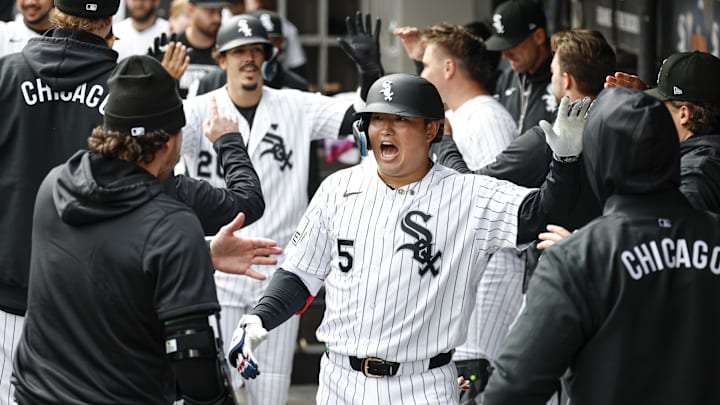
An active offseason for the White Sox was centered around one name: Munetaka Murakami. The White Sox shockingly prevailed in the pursuit of the Japanese star who brought the potential for game-changing power along with a fair amount of swing-and-miss concerns. Murakami’s short-term deal gives both him and the White Sox an opportunity to see what he can do before either side makes a long-term commitment. It’s only been nine games, but it’s become abundantly clear what the White Sox priority should be for 2026: keep Mune around long-term.
Through his first week and a half in the big leagues, Murakami holds a .955 OPS with four home runs. He’s walked six times and is tied for the team lead with seven runs batted in. As expected, his strikeout numbers are high, but that was always going to be a part of his game. The more important factors are the carry-over of his power and his ability to take walks. Murakami’s approach has been excellent against pitchers he’s never seen before, and he’s done a great job of making pitchers give him strikes with his approach. A 35% strikeout rate is high, but so is a 15% walk rate. Many players have productive careers as a three-true outcome hitter, and Murakami could be no exception.
Munetaka Murakami gives the @WhiteSox the lead right back!
— MLB (@MLB) April 4, 2026
His 4th of the season and his first in Chicago! pic.twitter.com/OkAWaZ3vUX
Murakami, who signed a two-year, $34 million deal in December, was definitely expected to have an adjustment period to big league pitching, but the production has been better than I thought it would be right off the bat. I’ve seen enough to feel like Murakami should be in a White Sox uniform for longer than two years, and I believe the time is now for the White Sox to capitalize and make him an extension offer he can’t refuse. The longer the White Sox wait, the greater the chance Murakami continues to excel and the more expensive his price becomes.
Murakami's extension will be expensive, but worth it
Many White Sox fans operate under the assumption that the team will trade Murakami before the end of his two-year deal. After all, the White Sox have never signed a player to a $100 million contract in franchise history. While teams like the Dodgers are giving out $300 million like it’s candy, the White Sox simply have never played in that market. It’s not that they’ve never tried. The White Sox had big offers on the table for Manny Machado and Zack Wheeler during their last competitive window, but the deals never came together. The team has shown a willingness to run a payroll close to $200 million when they’re trying to win, and the current payroll is nowhere in that ballpark. Theoretically, there’s plenty of payroll room to make Murakami a strong offer, it’s just a matter of desire.
At 26 years-old but with no MLB track record, Murakami might project somewhere between the deals for Pete Alonso and Vlad Guerrero Jr. It would require a significant financial investment on the part of the White Sox, but 40-homer power doesn’t just grow on trees. In Murakami, the White Sox have an impact hitter that brings the team many more benefits than just his contributions on the field. Murakami’s presence could help bring in more talent from Japan, and will introduce a whole new demographic of fans to White Sox baseball. That’s something worth keeping around.
While the running joke on social media says the White Sox are just warming Murakami up for the Dodgers, it doesn’t have to be that way. The White Sox have the motive, means, and opportunity to get a long term deal done with a player who could quite literally change the direction of their franchise. Letting it pass them by would be nothing short of a disaster.
 Add us as a preferred source on Google