

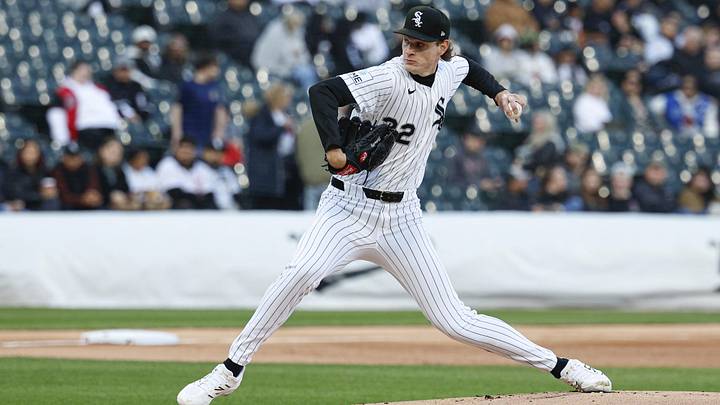
Pitching is hard. Pitching in your first big league season at 22 is even harder. Pitching as one of the tallest pitchers in baseball is about as difficult as it gets. Don’t believe me? Here’s one of the tallest pitchers in baseball history, Randy Johnson, describing the difficulty of it. Having gone back through some of Noah Schultz's several professional starts, one thing stands out to me. I don’t think he is fully using his unique, 6 feet 10 inch tall frame to the best of his abilities just yet.
Noah Schultz's results so far have been a mixed bag
Noah Schultz has not gotten off to as good a start as we would have liked in his first full season of Major League action. The highly touted White Sox prospect, through 38 2/3 innings pitched, is sporting a 5.82 ERA with an elevated 13.1% walk rate and a less than stellar strikeout percentage of 19.6%. Hitters are also slugging away at both his sinker (.487 SLG) and his changeup (.500 SLG). Additionally, he has been dealing with injury in the last few weeks.
He has made two rehab starts so far, one on June 16 and another on June 21. Through 4 1/3 innings of rehab work down in Triple A, he has struck out 8, which is encouraging, but he's also walked 4, which is not as encouraging.
HE GONE! Noah Schultz notches his first @MLB strikeout ✅ pic.twitter.com/2TrYlfrffr
— Chicago White Sox (@whitesox) April 14, 2026
This mechanical change could help Schultz see results
Before we continue, let’s get some quick definitions out of the way. Perceived velocity is essentially how fast a pitch is being perceived by a batter, compared to the radar gun speed. Jacob Misiorowski throws 100 mph on average, but his perceived velocity is 102.5 mph. If you have ever heard the phrase during a game broadcast, “his fastball plays up”, this is what they are referring to. What drives perceived velocity? A simple metric called extension.
Extension is how far down the mound a pitcher is releasing the ball (measured in feet). Generally speaking, shorter pitchers have shorter extensions and taller pitchers have longer extension numbers due to the length of their arms and legs. The MLB average for extension/height is 104%, meaning that most pitchers are essentially releasing the ball as far down the mound as they are tall. In 2026, Noah Schultz’s average extension is 6 feet 2 inches, placing in the 30th percentile of pitchers with at least the same number of innings as him.
Given that he is 6 feet 10 inches tall, I feel that there is definite room for improvement in this department. The biggest advantage to releasing the ball further down the mound is that you give hitters less time to react to what is being thrown and your fastball appears faster (a.k.a increased perceived velocity). Currently, Noah Schultz averages 95.4 mph on his fastball, with his perceived velocity matching that. If Schultz lengthened his extension by 8 inches to match his height, his fastball would be perceived at 96.5 mph, effectively giving him a free 1 MPH gain without actually throwing any harder.
Fooling hitters and making them uncomfortable is the name of the game as a pitcher. A tall, lanky mass of arms and legs flying down the mound and then releasing a fastball or sweeper from a distance closer than what most hitters see sounds pretty uncomfortable to me. I mentioned Randy Johnson earlier, but he was a guy who excelled at doing this. Here are some major league hitters describing just how uncomfortable at-bats against him was. By getting well below average extension, Noah Schultz is not effectively using his height to his advantage in the battle against hitters.
Should White Sox fans be concerned by the start of Noah Schultz's career?
The short answer here is no. He is still very young at just 22 years old and is still adapting to how he needs to be able to get major league hitters out. Randy Johnson struggled early in his career, particularly with walks, before finally figuring it out in his late-20’s and early 30’s. Noah Schultz has the height and lanky build to be Randy Johnson-lite; he just needs to figure out how to use his body effectively to do so. There is still plenty of time left to work out his mechanics to live up to his high prospect status. With Schultz set to return in the next couple weeks, we could see the results soon.
 Add us as a preferred source on Google