

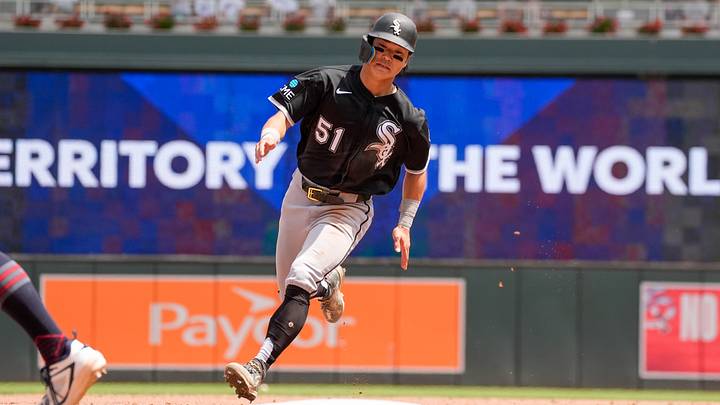
Rikuu Nishida was selected in the 11th round of the White Sox 2023 draft, and he stills rank on their Top 30 Prospects list on MLB Pipeline. He's advanced up to Triple-A and posted strong numbers all through the minors, currently sitting with an overall FV grade of 40. He even got a short stint in the majors earlier this year, when the Sox needed another outfielder, and he seemed like a potential candidate for another call-up when the September rosters expanded.
However, Nishida has a glaring flaw that keeps most evaluators from seeing him as an everyday player (a 40 FV grade usually translates to a bench role), and that's his lack of power. Nishida's scouting reports listed him with 20-grade power, which is the lowest possible score on the 20-80 scale. Future major league players don't usually have such a poor grade on a key offensive tool, and this could present an issue for Nishida going forward.
He's hit exactly two home runs in his professional career; the first in Single-A Kannopolis back in 2024, and the latter in his Triple-A debut in Charlotte. He played 12 games for the White Sox this year, and did not record an extra-base hit. In Charlotte, where he's spent most of the season, he has six doubles and two triples to go with his single homer, which comes out to a .323 SLG (compared to a .289 BA).
Rikuu Nishida had his arm tested early in his debut …
— MLB (@MLB) May 25, 2026
And he threw a perfect strike 🎯 pic.twitter.com/mXLtABXEIJ
Nishida's near inability to record extra-base hits (even with good speed) makes him an outlier among players. Using comparisons isn't the best way to evaluate Nishida's own chances, but in this case, it's the best option. Have there been players with similarly poor power who have found big league success?
The short answer is, but with a couple caveats. Whenever a player has a key deficiency, they usually need some other big, elite skill that can make up for it. To me, that's Nishida's biggest problem; while he's a pretty good player aside from the power, he doesn't have anything that stands out enough to justify regular playing time.
Take Ozzie Smith as one example; he's probably the most generous forecast for players in Nishida's situation. Smith spent nineteen seasons in the big leagues and eventually made the Hall of Fame, but he only hit 28 career home runs. He was not even a hugely effective hitter otherwise--he had a career OPS of .666, with 87 OPS+ per Baseball Reference. Those numbers would look better if he could slug, but he still only managed a .337 career-OBP, which is much lower than what Nishida puts up. Smith had a great career because he's probably the best defensive shortstop of all-time; that made up for a lack of offensive ability.
Nishida does not play a key defensive position; he primarily plays second base and the outfield corners. The latter are bat-first, power positions. Second base is an up-the-middle spot, but it's considered less valuable than shortstop or center field. Maybe this is okay; expecting someone to be an all-time great isn't realistic, and Nishida doesn't need to be in the Hall of Fame. A better comparison might be a player who gets regular playing time without a key, generational specialty.
Rikuu Nishida could use his speed and OBP to carve out a role on a big league roster
In this case, the best example is probably Myles Straw. He's a modern player in his ninth major league season, and he also had 20-grade power. He's a much better comparison to Nishida--Straw can play multiple defensive positions, although he most commonly plays center field. He's fine, but not elite, at the position. But he's a solid hitter, with an on-base ability similar to Nishida's. Straw's career line on Baseball Reference is .245/.314/.319/.634 (77 OPS+). He doesn't play full seasons most years, but he gets fairly regular time. If he's the best comp, Nishida might not be an everyday player, but he could still be an important piece of a major league roster, which is good enough.
What's encouraging is that, like Nishida, Straw really doesn't hit any homers, even now that he's more experienced. His career-high is 4, and there have been years where he doesn't hit any. In 2022, he played 152 games with zero home runs. And he actually hit even less homers in the minor leagues, never getting more than one in a season before he reached the majors. That means Nishida could potentially improve his home run output if he got more major league chances. That would make his numbers more palatable, especially because SLG% is such a big part of a player's OPS.
Nishida will still need a key skill to justify regular time, even if it's not a historic talent like Ozzie Smith. While he steals a lot of bases, Nishida's best talent is an elite OBP, which often sits at or above .400. It was .424 in Triple-A this year, against pretty tough pitching competition. That on-base is a huge advantage, and it could be a difference-major for him. I don't see him as a starting right fielder, or even a starting second baseman, but he could have a good career as a platoon lead-off hitter against lefties.
Hopefully Nishida has another good season in 2027, and the White Sox find a way to give him more playing time. That OBP is a good skill, and it could really bring in some runs on a major league team. It's also nice to see a player with a unique skill-set find a way to utilize his talents, and Nishida's a perfect example of that.
 Add us as a preferred source on Google