

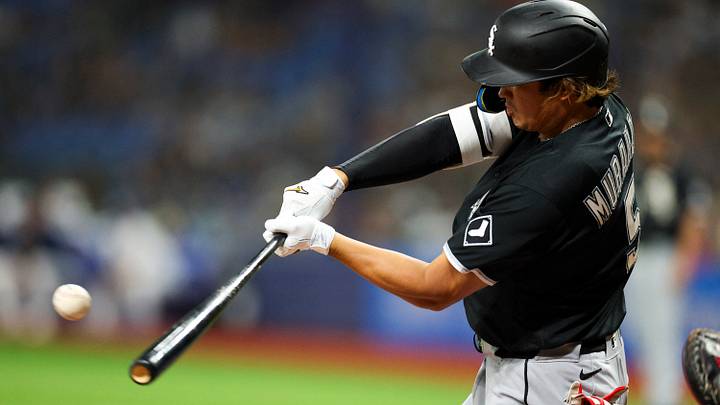
When the White Sox signed Munetaka Murakami out of free agency, the reaction was split between excitement about his power, and concerns about his swing-and-miss. He was an MVP and Triple Crown winner in Japan's NPB, while holding that league's record for most single-season homers by Japanese player (with 56). But his strikeout rate was 28% in 2025 and almost 30% in 2024 (180 strikeouts, in 610 plate appearances), leading to concerns about how well his skillset would translate and allowing the White Sox to sign him for just two-years and $34 million.
I had trouble seeing him as a washout risk, but I could see where the concerns he came from.
He was, without a doubt, a three-true-outcome hitter. That's a hitter who gets walks, strikeouts, and home runs, but not much else else. Unlike some high-strikeouts hitters, his batting eye was good, but if he couldn't make regular contact, he wouldn't reach base enough and his legendary power wouldn't play.
Those questions were alleviated early in his career. Murakami slugged a homer in each of his first three MLB games, and hit 12 total between March and April. He had 25 walks and 46 strikeouts during that time, which comes out to a 34% K%, and an 18% BB%. For comparison, league-average is about 22% for strikeouts, and 8.5% for walks.
As fun as it was to watch, those early-season numbers didn't feel sustainable. I was pretty high on Murakami when he was a free agent, and I don't mind three-true-outcome bats if they can make it work. But even I thought something would have to give, and he'd either start making more regular contact, or his impact would regress.
But here we are in mid-August, with about 40 games left in the regular season, and Murakami is still the White Sox best hitter without changing his game very much. He has a 17% walk rate, a 33% strikeout rate, 28 homers in 383 PAs, and his Whiff% is in literally the bottom percentile (at 42%).
MUNETAKA MURAKAMI 2-RUN HOMER FOR THE LEAD! pic.twitter.com/gTiwIYeP4i
— MLB (@MLB) August 16, 2026
Murakami's combination of power and plate discipline is a rarity in baseball
Fangraphs has tool that ranks players by PAs ending in one of the three-true-outcomes. Kyle Schwarber ranks first among qualified hitters, at 56.2%. But Murakami doesn't qualify because he spent six weeks on the injured list. Among hitters with at least 350 PAs, Murakami ranks first, with 57.6% of his plate appearances ending in one of the three outcomes--almost a full percentage point more than Schwarber. He also has the third-highest strikeout rate, the fourth-highest walk rate, and second-most home runs per plate appearance (for hitters with 350+ PAs). He's not just a three-true-outcome hitter, he's reinventing that profile.
Everyone loves Murakami's power, and I don't disagree. But I think his on-base skills are what makes him special. He's hitting .235, which would usually make him, at best, a purely a boom-or-bust bat whose an easy out more often than not. But his OBP is .370, and on August 13th, he ended a 27-game on-base streak only because he got a pinch-hit appearance late in the game.
Hitters with 33% strikeout rates rarely carry 30-game on-base streaks. But Murakami is just so patient when he comes to bat.
He's scored 63 runs this season, despite spending six weeks on the injured list, but that's not the only benefit of a good OBP. You get 27 outs in baseball. Every time Murakami doesn't end up out, he's not contributing to the end of the game, or to the White Sox not scoring. He's literally helping with what he doesn't do, in addition to what he does do.
The worst thing about high-strikeout players is that their PAs are just a waste too often, because they don't reach base, they don't put the ball in play, and the game is one out closer to ending. But Murakami is one of the toughest outs in the line-up, before you even factor in his damage.
I thought he'd be a package deal. You get the homers and walks, so you tolerate the strikeouts and the low averages. I expected that would be a major trade-off, but he's gotten so good at his craft that it's hard to complain. He's a tough out who does a lot of damage, and he's not showing signs of slowing down.
 Add us as a preferred source on Google