

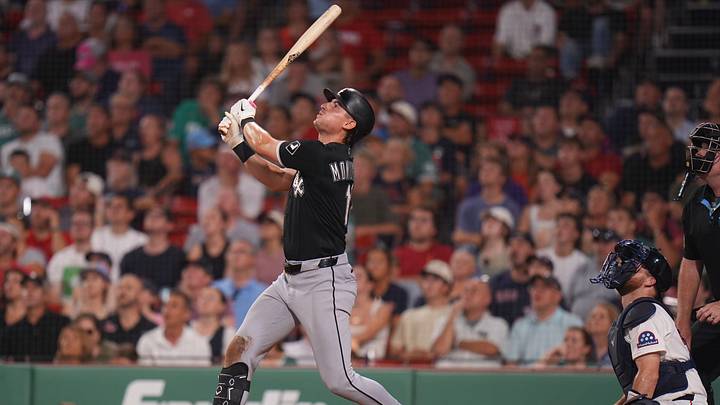
Colson Montgomery went 0-4 against the Cincinnati Reds on Tuesday, dropping his season batting average to .213
That sounds like a bench player, or even someone on the verge of getting DFA'd. But Montgomery is one of the White Sox strongest offensive contributors, and that low average is combined with a .735 OPS, a 104 OPS+, and a team-leading 26 home runs.
Montgomery has had a few slumps this year, and his offensive numbers have dropped since 2025. Last year, he played 71 games, hit 21 home runs and had a .840 OPS, despite a .239 average.
That was his first season, and fans hoped he'd improve his contact with time. They looked past his averages last year, because his power was so good. The question is whether that's still true in 2026.
According to Baseball Reference, the league-average batting average is around .245. That means Montgomery was barely below the average last season, with very high slugging numbers. But a .213 average is tough to swallow for any hitter. With an average that low, there needs to be strong power or on-base ability to make up for it. Montgomery has said himself that he doesn't think much of average, and that's reasonable for a hitter like him, as power-hitters often run low averages. But there's a point where it starts to matter, and Montgomery could be facing this.
Montgomery's teammate, Munetaka Murakami, also has low batting average (.237), and there were concerns about his contact when he entered MLB free agency. But he makes up for his inconsistent contact by posting a very high walk-rate, and he's currently on a 26- game on-base streak.
Montgomery's OBP is .294. Baseball Savant gives him an 8.2% walk rate, which is a hair below the MLB average of 8.4%, per Baseall Savant. Not terrible, but not enough to make up for his lack of hits. His strikeout rate is 33%, which is about 10% worse than league-average. Anecdotally, I look at the box scores and it's often a line of zeroes.
But maybe we should forget averages, and look at impact. His OPS+ and wRC+, two metrics that are meat to show a player's offensive production, have him right at league average. Montgomery is at 104 for the former, and Fangraphs gives him a 103 wRC+. Those are drops from last year, but still perfectly acceptable--you can't get that mad about league-average.
And maybe that's the overall answer. With big power and poor contact, Montgomery becomes just a league-average hitter. That still doesn't seem fair--his 68 RBIs are tied for 11th in the American League, and that's something neither of the above metrics factor in. Along with Vargas and Murakami, he gives the line-up three big power hitters in the heart of the order, which gives them three big opportunities to drive in runners.
Colson Montgomery puts the @WhiteSox ahead with a 3-run shot! pic.twitter.com/4XfvTpwbqO
— MLB (@MLB) August 9, 2026
Montgomery's strong power and defense make him a valuable player regardless of contact
If you don't like clutch, you can also look at Montgomery's defense for more value. He's a very good shortstop. Fangraphs has him with +4 OAA and +4 FRV (last year he was a +6 defender in both categories). He's played almost 700 innings there this year, and should have no trouble sticking long-term. Think about all the power-hitters who play 1B or the outfield corners, and do so poorly, but make up for it with their bats. Montgomery plays one of the hardest spots on the field, and does it well.
If he's a league-average hitter with a good glove at short, and power upside, he's a very valuable baseball player. But I want him to reach that higher, more consistent level with his bat, and I think he can get there.
He does make hard contact. He has a 12.6% Barrel% rate, compared to a league-average of 7.6%. Baseball Savant has his bat speed in 94th percentile, and his Hard Hit% is 41%, compared to a league average of 37%. It seems to me that, if he's hitting the ball hard, everything else should be fixable. The problem is that his chase rate is high (just the 30th percentile), and his whiff rate is very high; 37.5% compared to the 25% league average.
The chases and swings-and-misses were problems last year, too, but they've both gotten worse, and it's hurt his averages. If he can dial back on both, his contact will be more regular--a .230-.240 power-hitter is much more tolerable than .213 one. And his power, already great, would get even better with improved contact.
But overall, he's a hitter you take for what he is. Inflated strikeouts and poor contact rates are part of his game; he has a long swing and he's aggressive at the plate. What you get is a hitter with great power, lots of RBI, and a surprisingly good glove. That's worth a sport on your roster, even if the averages aren't there.
 Add us as a preferred source on Google