

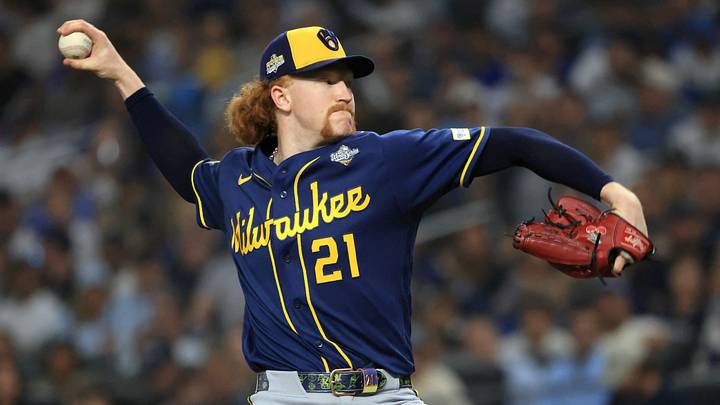
Like most, my immediate reaction to the Dustin May signing news was that the Chicago White Sox had grossly overpaid for a starter with a ridiculous injury history and limited track record of success. MLB Trade Rumors had forecasted that the right-hander would earn $30 million over two years; the Pale Hose wound up giving him $52.5 million over three.
Clearly, Chris Getz and Brian Bannister believe there's more to uncover with May, who is still only 29 years old and was once one of the most highly regarded pitching prospects in the sport while in the Dodgers organization. Plenty of fans will rightly be dubious considering his struggles down the stretch (5.65 ERA) and in the postseason (5.73 ERA) with the Brewers, but he was worth 2.8 fWAR this past season on the strength of an impressive tenure with the Cardinals (3.15 FIP).
There's certainly a lot of work to be done to get him to live up to this new contract, so it's worth diving into May's profile to see what the White Sox are truly investing in.
Dustin May (signed with CWS) is a hard-throwing righty with incredible spin capacity. He was a sought after arm each of the last two trade deadlines and now lands a multi-year deal. His underlying metrics were much stronger than his near-5 ERA would indicate and he adds firepower… https://t.co/bs0DnxvDpg pic.twitter.com/rIChBAetx2
— Thomas Nestico (@TJStats) November 17, 2026
Dustin May brings upside to White Sox's rotation, but he doesn't fill the ace quota
The good news is that the primary concern with May -- his health and durability -- has largely been mitigated. After failing to complete even 100 innings in any big-league season following his debut in 2019, he's exceeded 130 frames in each of the past two years. He may never be a true innings-eater, but it's no longer unrealistic for him to make each of his scheduled starts.
The real goal, then, is to get him to harness his raw stuff and turn it into more reliable production. May was one of the pioneers of the three-fastball revolution, featuring a four-seamer, sinker, and cutter as his primary offerings. The latter has become his best pitch, generating +6 run value this year and a 24.4% whiff rate. The problem is that his other two heaters were clobbered (hard-hit rates above 50%) and tended to bleed into each other when looking at his velocity and movement profile.
It'll behoove the White Sox to get May to fall back in love with his sweeper, which is one of his few offerings that is effective against both right- and left-handed hitters and was a great pitch as recently as last year (+5 run value). It has one of the highest spin rates in the majors, which helps May generate some profound movement along the horizontal plane.
The right-hander doesn't strike out quite as many hitters as you'd expect for someone with his premium spin and velocity, but a 23.2% strikeout rate is both above average and totally acceptable. The key will be helping him keep the ball on the ground, since his results immediately suffered once batters started lifting their hard contact more frequently once he landed in Milwaukee.
Really, the most frustrating thing about this deal is that the White Sox are spending big money on a pitcher who decidedly isn't an ace. May's 2.8 fWAR in 2026 would have tied Sean Burke for the team lead among pitchers -- there's no denying he should be a positive force for the rotation, especially if the coaching staff can unlock something more within his arsenal. But if this contract precludes the team from pursuing a genuine frontline arm, it's going to be hard to reconcile in the years to come.
 Add us as a preferred source on Google